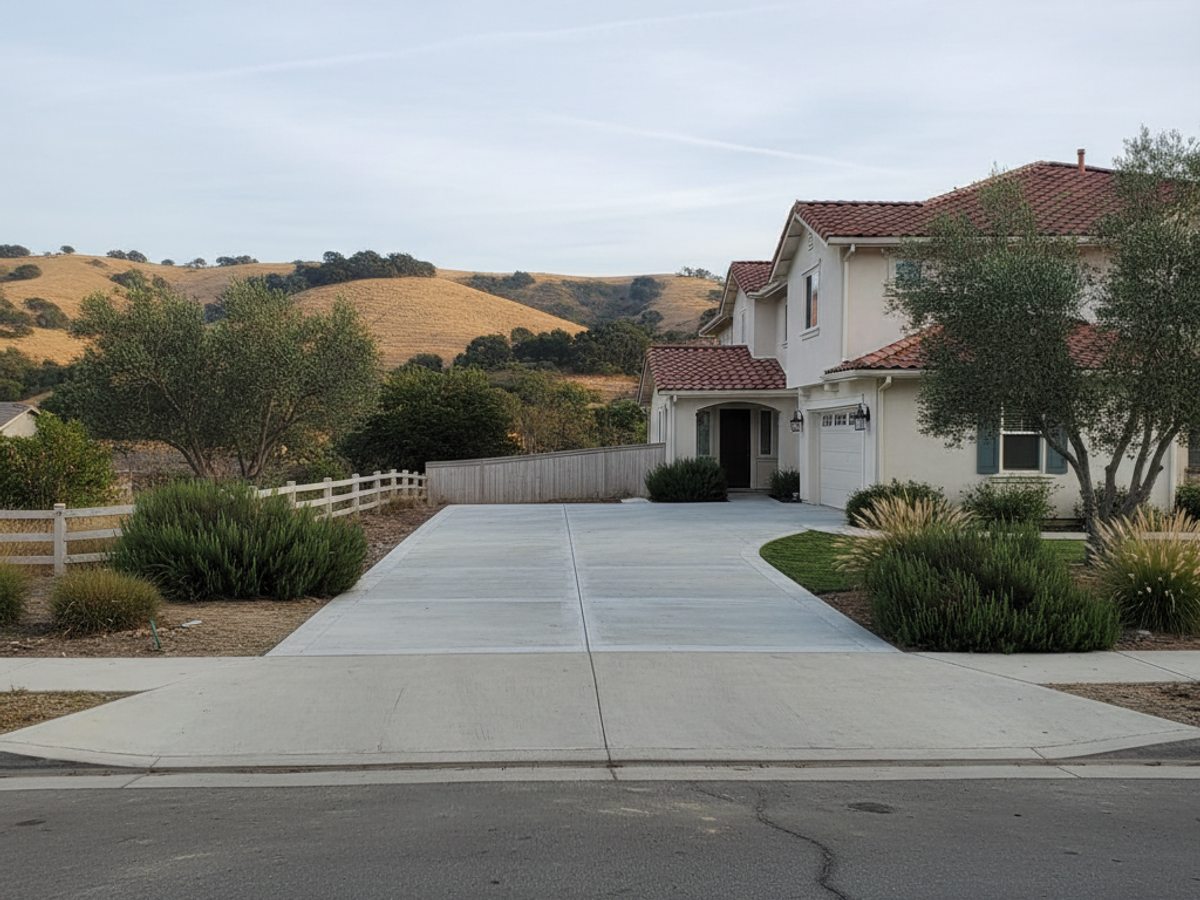
People assume concrete just needs to dry. It doesn't dry, it cures, and that's a chemical reaction between cement and water that keeps going for weeks. Temperature and moisture control how fast that reaction happens and how strong the slab ends up. In San Bernardino, that means the calendar matters more than most homeowners think, because we swing from 105-degree July afternoons to soaking storms in February with not much mild weather in between.
What summer heat actually does to a pour
June through September here, slab surfaces sitting in direct sun can hit well over 100 degrees even when the air temperature reads 90. Hot concrete loses its surface water to evaporation faster than the mix can bleed water up from below. When that happens you get plastic shrinkage cracks, thin surface cracks that show up within hours of finishing, before the slab has any real strength to resist them. The fix isn't complicated but it takes planning. We pour early, often before 7am, so the bulk of the finishing work happens before the heat peaks. We use evaporation retardants or fog the surface, and we get curing compound or wet burlap down fast instead of letting the slab sit exposed. Santa Ana wind events make this worse, not better, because wind pulls moisture out of fresh concrete even when the temperature itself isn't extreme.
Stamped concrete is especially unforgiving in summer. You're racing the set time to get stamps in before the surface skins over, and in 100-degree heat that window can shrink to 20 minutes instead of an hour. If a crew isn't used to working fast in that heat, the texture comes out shallow or uneven.
Why late fall through early spring works better
Most of the year here outside of summer gives you daytime highs in the 60s and 70s, which is close to ideal for concrete. Slower evaporation means a more controlled cure and a harder, less porous surface in the end. October through April is when we do a lot of driveways and patios for exactly that reason. You still get some cold mornings, especially up toward Highland and the foothill neighborhoods, but San Bernardino rarely sees a hard freeze. A light frost won't hurt a slab the way repeated freeze-thaw cycles do in colder climates. That's one advantage of building here that places like the Midwest or the mountain towns east of us don't get.
The rainy season problem nobody mentions
Our rain mostly falls December through March, and it tends to come in short, heavy bursts rather than steady drizzle. That's a scheduling headache more than a quality problem. You can't pour into standing water, and a sub-base that's saturated won't compact right, so a storm the day before a scheduled pour can push the whole job back a week while things drain and dry out. It also affects excavation and grading work ahead of a slab or retaining wall, since wet clay-heavy soil gets heavy and sticky and doesn't want to hold a grade. We watch the forecast closely in those months and build in flex days, because rushing a pour around a storm front causes more problems than waiting three days does.
What the ground here is actually doing underneath you
Most of the San Bernardino valley floor is alluvial soil washed down out of the San Bernardino Mountains over thousands of years, mostly sandy loam that drains fast. That's generally good news for concrete work, since a well-draining base reduces the risk of water sitting under a slab and causing heave. Some flatter areas and older parts of town carry more clay content mixed into that soil, and clay expands when wet and shrinks when dry. If your lot has more clay, the time of year you excavate matters, because digging and compacting a base in the middle of a wet spell gives you a softer, less stable base than doing the same work in a dry month. We test and adjust the base rock depth depending on what we find, usually 4 inches for a patio and more like 6 to 8 inches under a driveway that's going to carry vehicle loads.
Permits, HOAs, and the paperwork side of timing
A new driveway, a slab addition, or a retaining wall over about 4 feet usually needs a permit through the City of San Bernardino or the county if you're in an unincorporated area nearby. Driveway aprons that tie into the public sidewalk or curb often need a separate encroachment permit since that strip belongs to the city, not the homeowner. Inspections typically happen at two points, after the forms and base rock are set and before the pour, and sometimes again after. None of that changes with the season, but permit offices do slow down around the holidays, so if you want work done in January, it pays to start the paperwork in November. Newer subdivisions in north San Bernardino and up toward Highland tend to have HOAs with their own approval process for anything visible from the street, which can add another two to three weeks before a crew ever shows up. Older neighborhoods closer to downtown generally don't have that layer.
How long before you can actually use it
Concrete reaches roughly 70 percent of its strength in the first week and keeps gaining slowly up to full strength around 28 days. Practically, that means foot traffic is usually fine after 24 to 48 hours, you can park a car on a new driveway after about 7 days, and we tell people to hold off on anything heavy, like an RV or a loaded trailer, until the full 28 days are up. Hot weather speeds up the early strength gain but can leave the slab weaker overall if it dried out too fast on the surface. Cooler weather slows everything down but tends to give a denser, more durable finish, which is part of why we like scheduling bigger driveway and patio jobs for fall and winter when the weather cooperates.
There's no single month that's wrong for concrete in this part of the Inland Empire, but some months take more work to get right. If you're planning a driveway, a patio, or a repair and want to talk through timing for your specific property, Heritage Concrete Solutions can walk you through what the schedule looks like for your job.