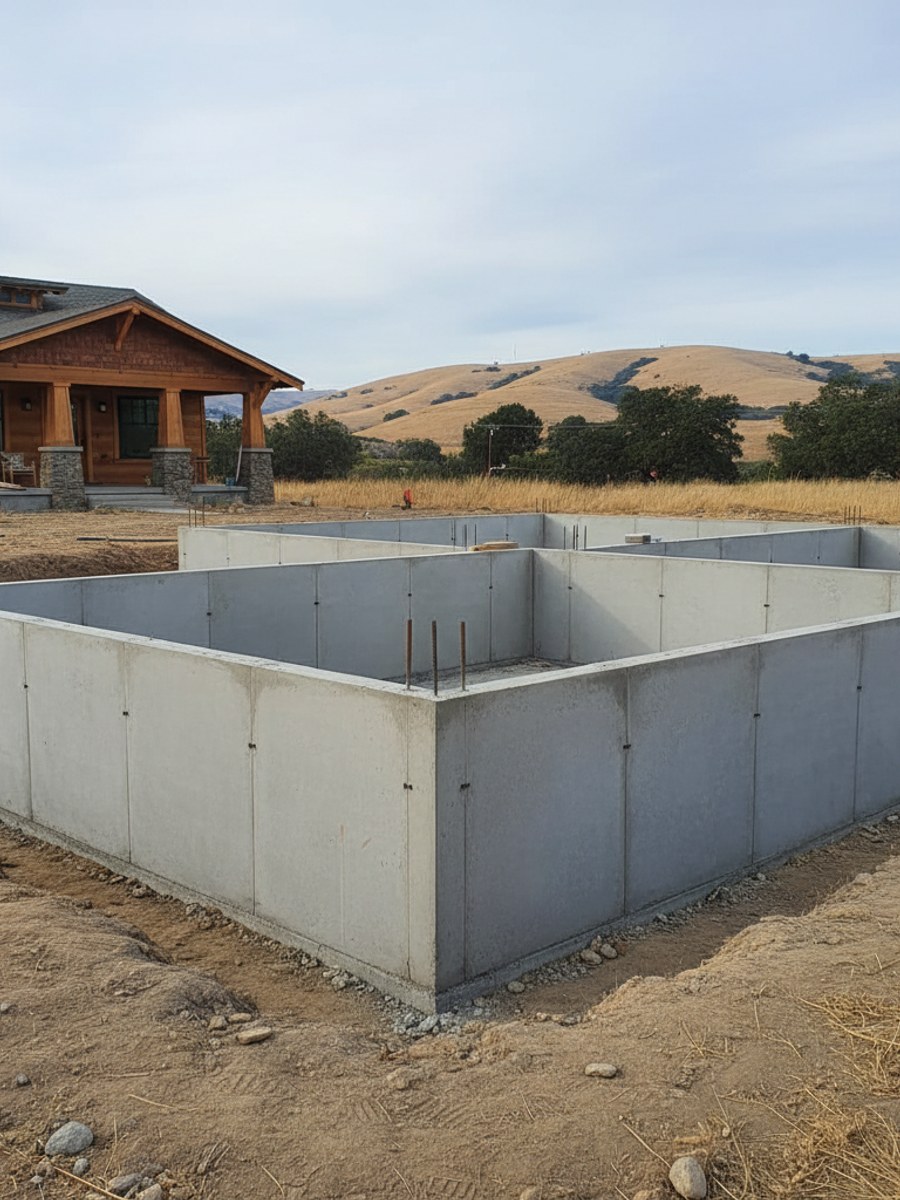
Most of the concrete problems we get called out to fix started before anyone ever mixed a bag. The pour itself is maybe a day or two of the job. Everything that decides whether that slab is still flat and crack-free in ten years happens in the week before, usually when nobody's paying attention to it.
Here's what actually matters, based on what tends to go wrong around this part of the Inland Empire.
1. Know what's under the dirt
San Bernardino sits in a basin fed by alluvial fans coming off the mountains, so you get a mix on most lots, sandy loam in some spots, denser clay pockets in others, sometimes within the same yard. Clay holds water and swells, then shrinks hard when it dries out in July. If your contractor doesn't dig a test hole or ask about soil behavior on your specific lot before quoting, that's a gap. A slab poured over unstable clay without proper base prep will crack along predictable lines within a couple of seasons.
2. Call 811 before anyone breaks ground
This is free and it's the law. Underground Service Alert marks gas, electric, water and sometimes irrigation lines. Older neighborhoods near downtown San Bernardino and parts of Highland have had decades of additions and repairs, so what's actually buried doesn't always match the original plans. A rented trencher through a gas line is a bad afternoon for everyone.
3. Figure out where the water goes
We don't get much rain here, but when it comes, in January and February mostly, it can come hard off the mountains and the storm drains on older residential streets weren't sized for it. Grading matters more than people think. Concrete should slope away from the house, generally a quarter inch of fall per foot, enough to move water without being so steep it's uncomfortable to walk on. A patio or driveway poured dead flat, or worse, sloped toward the foundation, will send water into your crawl space or garage the first real storm you get.
4. Sort out the permit situation
Whether you pull a permit through the City of San Bernardino or the county depends on exactly where your property sits, and that trips up a lot of homeowners who assume it's all one office. Driveway work, retaining walls over a certain height, and anything that touches setbacks usually gets inspected. If you're in one of the newer developments out toward Rialto or Redlands with an HOA, check with them too, separate from the city. HOAs often have their own rules on finish color and height for anything visible from the street.
5. Ask about base rock, not just the concrete
The slab is only as good as what's under it. A proper base is compacted aggregate, usually 4 inches for a patio, more like 6 for a driveway that's going to see vehicle weight. Skimping here is invisible once the concrete's down, which is exactly why it gets skipped by contractors trying to save a day on the schedule. It's also the number one reason a slab settles unevenly.
6. Rebar or wire mesh, know which you're getting
Wire mesh is cheaper and fine for a lot of patios and walkways. Rebar, typically No. 3 or No. 4 bar on a grid, holds up better under driveway loads and where you've got any soil movement at all. Ask which one is going into your quote. Mesh that sits at the bottom of the pour instead of being chaired up in the middle of the slab does almost nothing, and that's a common shortcut.
7. Control joints need a plan, not a guess
Concrete cracks. That's not a defect, it's physics, the question is whether it cracks where you want it to. Control joints, saw-cut about a quarter of the slab's depth, should go in within 24 to 48 hours of the pour, spaced roughly every 8 to 10 feet for a standard driveway. Skip this or wait too long and the slab picks its own crack lines, usually right through the middle of your new patio.
8. Ask how long before you can drive or walk on it
Foot traffic is usually fine after about 24 to 48 hours. Vehicles need longer, 7 days is the standard wait, sometimes more if the pour happened during a stretch of 100-degree days in July or August, which we get plenty of. Heat pulls moisture out of curing concrete fast and can cause surface cracking if nobody's keeping it damp or covered in the first few days. Ask what the plan is for curing in summer heat specifically, not just what the schedule says on paper.
9. If it's repair or resurfacing, find out why the old slab failed
Resurfacing a cracked or pitted driveway looks great for a while, but if the crack came from a tree root or unstable fill soil underneath, it's coming back. Older neighborhoods in San Bernardino, some built in the 1950s and 60s, often have mature trees with root systems that have had sixty years to work their way under a driveway. Patching over that without addressing the root is a short-term fix.
10. Get it in writing, including what happens if it rains
Get the mix design, the thickness, the rebar spacing and the joint layout written down, not just a verbal promise. Also ask what the contingency is if weather delays the pour. It doesn't rain often here, but a surprise storm in February can push a schedule back a week, and you want to know ahead of time how that's handled rather than finding out mid-project.
None of this is complicated, but it's easy to skip when you're just trying to get a quote and a start date. We walk through all ten of these with every homeowner before we schedule a pour. If you want to talk through what your specific lot needs, that's what Heritage Concrete Solutions is here for.